
Outsourcing and dedicated teams are often compared as if they are two versions of the same thing. They are not. Outsourcing buys a defined scope. A dedicated team buys engineering capacity that works inside your product organization. The contract may look similar; the operating model is not.
The right choice depends on how much of the work can be specified in advance, how much product discovery is involved, and how long you need the capability.
Three models, not two
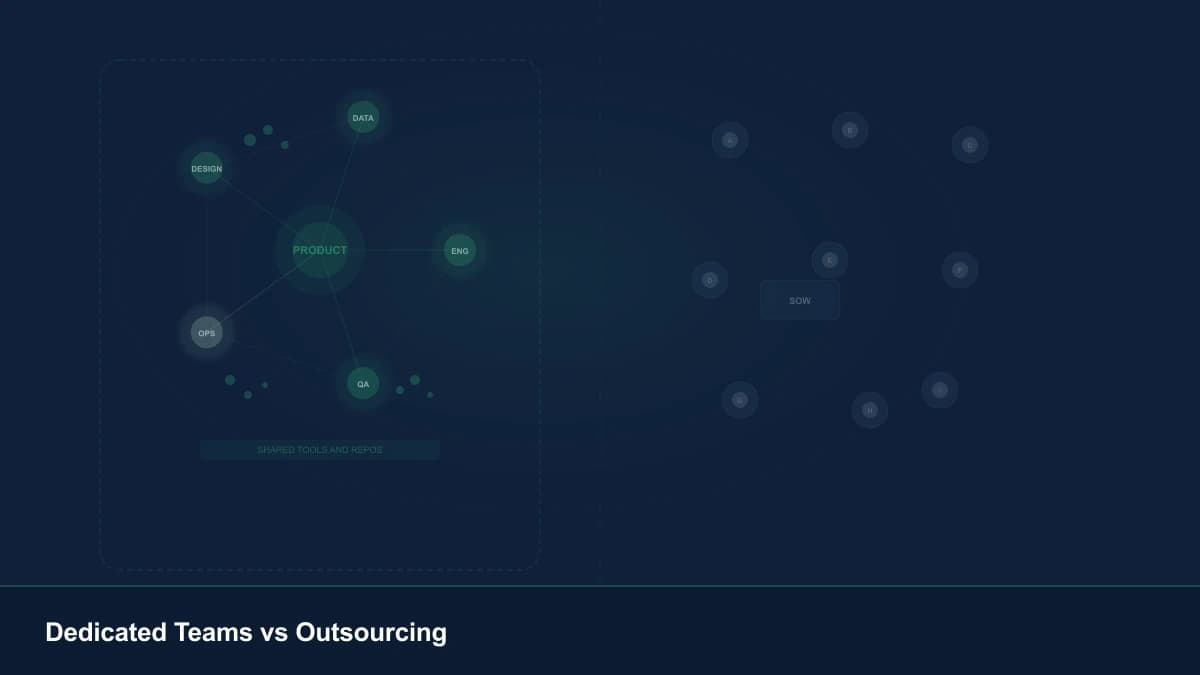
- Project outsourcing: a provider owns a fixed scope and delivers against a statement of work. You manage outcomes and accept less day-to-day control.
- Staff augmentation: individual specialists join your team. You own direction and delivery; the provider supplies people.
- Dedicated team: a long-lived pod owns a stream of work with your product direction, your rituals, and your standards. Accountability is shared but continuous.
Most disappointing engagements are mismatches between the model and the work, not failures of a country or a vendor.
Where project outsourcing works
Outsourcing is a good fit when the work is bounded, well understood, and separable from the core product:
- A defined migration, integration, or platform upgrade.
- A short, specialist build with acceptance criteria that can be written down.
- Non-core work where internal context adds little value.
- A one-off deliverable with a clear end date and a clean handover.
Where outsourcing breaks down
Outsourcing struggles when the work is exploratory or continuous. Product development is full of decisions that depend on customer feedback, internal constraints, and trade-offs that cannot be specified in advance. A statement of work turns every new insight into a change request, which slows learning and rewards scope protection over outcomes.
It also weakens knowledge retention. When the scope ends, the provider leaves with the context, and the next initiative starts from a colder position.
What a dedicated team actually means
- The team joins your planning, reviews, stand-ups, and release cadence rather than running a parallel process.
- Your product direction sets priorities; the provider supplies engineering leadership and delivery discipline.
- The same engineers stay on the work long enough to accumulate domain knowledge.
- Code, documentation, and decisions live in your repositories and your tools.
- Success is measured against product outcomes, not billable hours or ticket throughput.
Without those conditions, a dedicated team becomes expensive staff augmentation with a longer contract.
Compare total cost, not hourly rate
Rate cards are the easiest thing to compare and the least useful. The relevant number is the total cost of delivering outcomes over time:
- Onboarding time: how long until a new engineer can ship safely without supervision?
- Turnover: what happens to context when someone leaves, and who bears the replacement cost?
- Management overhead: how much internal time goes into supervising, translating, and unblocking?
- Rework: what proportion of output survives review and production?
- Knowledge retention: does capability accumulate inside your organization or the vendor's?
- Opportunity cost: what does the model prevent you from doing?
The control question
Control is not about hierarchy. It is about who can make which decisions, and what happens when the two sides disagree. Put it in writing before onboarding:
- Decision rights: product priorities, architecture, hiring, and release approval.
- Code and IP ownership, including work produced during discovery.
- Security expectations: device policy, access management, data handling, and incident response.
- Reporting: what is measured, how often, and in which tools.
- Escalation: who resolves disagreements, and at what level.
Time zones and communication
Overlap hours matter less than decision latency. A team with four shared hours and a strong written culture can move faster than a team with eight shared hours and an oral culture. Ask how decisions are recorded, how work is handed over, and what happens when a question arrives outside overlap.
An evaluation checklist
- Can the provider describe how they have integrated with a client's product process, not just delivered a scope?
- Who owns architecture decisions, and who has final say?
- How are engineers selected, and how long do they typically stay on an engagement?
- What does onboarding look like for a new engineer joining mid-stream?
- How is code reviewed, tested, and released?
- What happens when priorities change mid-quarter?
- How do they handle security incidents and access reviews?
- What metrics do they report, and what do they refuse to be measured on?
- What does the exit look like, including knowledge transfer?
- Can you speak to a client whose engagement ended?
Common failure modes
- Hiring a team without a product owner who can set priorities.
- Treating the team as ticket-takers and then wondering why ownership is missing.
- Skipping onboarding and expecting context to transfer by osmosis.
- Measuring activity instead of outcomes.
- Keeping a provider because switching feels expensive, long after the fit has stopped working.
A dedicated team is not a cheaper version of hiring. It is a different way of buying capacity, and it works when both sides behave as one engineering organization with clear boundaries and shared accountability.
Frequently asked questions
Is a dedicated team the same as staff augmentation?
No. Staff augmentation supplies individuals you manage directly. A dedicated team is a self-managing pod with delivery responsibility that integrates into your roadmap and rituals. The provider carries more of the management and delivery burden.
Do we lose control of the work?
You should not. Put decision rights in writing, keep code in your repositories, join the same reviews and planning sessions, and agree on how priorities and releases are approved.
How should we start with a dedicated team?
Begin with a bounded but real stream of work, a named internal product owner, and explicit success criteria. Expand once the team has demonstrated delivery and integration, not before.
Related engagement model
Dedicated TeamsWritten by
Atsol Engineering
Atsol Engineering is the editorial team at Atsol Inc., an international software, AI, and engineering studio.
About Atsol